
When Success Becomes Survival: The Hidden Fatigue Of Singapore
A paradox of success by Zhao Chenguang
Published on 12 August, 2026.
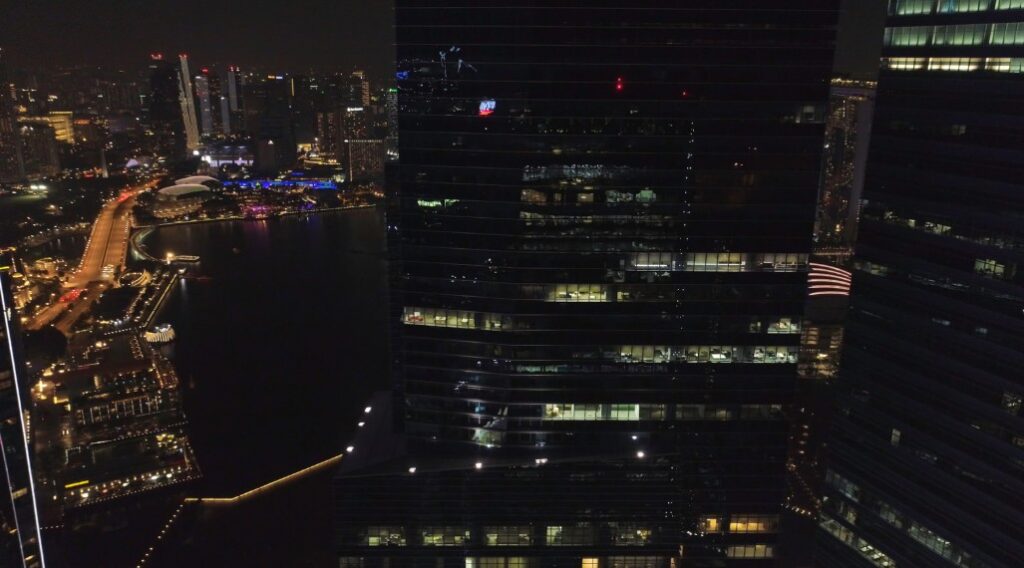
Enter Singapore, a country widely acclaimed for its success as a small nation state. Venture to the central business district on a weekday evening, and you will find office towers brightly lit well after working hours. Nationwide, students scramble one on top of the other in the chase for credentials and internships to boost their perceived value, in what Channel NewsAsia deems a “rat race”.
Such phenomena, while seemingly isolated cases at first glance, serve as implicit evidence of a broader trend. Singapore has achieved significant success in terms of high income levels, public safety, and institutional efficiency, yet surveys and discourse increasingly point to a younger generation being more and more overwhelmed — caught between constant pressure to perform and a persistent sense that it is never quite enough.
This tension is described by the term involution – also known as “neijuan” in Chinese – coined by American anthropologist Alexander Goldenweiser in as early as 1937 and popularised by social media in Mainland China the early 2020s. Involution occurs when n effort increases but returns diminish, when competition intensifies, but outcomes stagnate.
This tension raises a question. If Singapore’s meritocratic model continues to succeed as planned, why does advancement feel increasingly onerous? Is this competition natural…or something deeper?
Effort escalation as survival
At the individual level, the behavior driving involution is not irrational obsession, but rather simple logic.
In many sectors critical to Singapore’s booming economy – such as housing, education and employment – success is rarely defined by how well one does in absolute terms, but rather a status conferred through how one compares to others. A prestigious degree, a high ranking job, or a desirable residential location derives value only because not everyone can have it.
Economists (most notably Fred Hirsch) refer to such goods as positional: their value lies not in what they are, but rather how scarce they are.
This explains a dynamic that we know all too well. When some individuals increase their effort – be it through higher qualifications, longer working hours, or stacking internships – others must follow suit in order to avoid lagging behind. Once this phenomenon becomes ubiquitous, the increased effort persists, but the relative advantage disappears.
This results in an arms race – where everyone works increasingly harder, but no one really manages to meaningfully pull ahead.
A good example would be credential inflation which plagues us today. Over time, baseline qualifications for many jobs have risen, without a commensurate increase in the number of desirable positions. On a similar note, higher income levels do not always translate into improved wellbeing, as corresponding costs with regards to education, career prestige and other status-linked goods rise simultaneously.
Henceforth, today’s society becomes characterized by people working ever harder to stay ahead, only to paradoxically have no one gaining any real advantage. In such a system, standing still is not an option — because everyone else is moving. Involution is therefore not simply a matter of overwork, but a structural trap — one that can leave individuals feeling constantly pressured, yet unable to meaningfully move forward.
But if competition is rational, why is it especially suffocating in Singapore?
The amplifying effect of meritocracy
To answer that, we have to first understand how Singapore’s political and institutional framework exacerbates these pressures. Meritocracy, long a central organising principle, rests on the premise that effort and capability are the main determinants of outcomes. It has historically underpinned both economic performance and social legitimacy, forming the basis of a wider social compact – that those who put in effort will be rewarded fairly.
However, the robustness of this social compact also legitimizes endless competition. When outcomes are perceived to be fair, failure becomes difficult to attribute to anything other than one’s shortcomings.
High-stakes educational sorting, which begins at an early stage in life, channels individuals into differentiated pathways based on perceived capabilities. While this promotes an efficient allocation of talent, it also amplifies the negative consequences of underperformance. The implications are not just economic, but also moral – that falling behind, on top of being a disadvantage, is also a personal inadequacy.
Recent reforms of the Primary School Leaving Exam (PSLE) – a high stakes exam that is taken at twelve years old in order to sort students into different secondary schools – signal both an awareness of this problem and the sheer difficulty of mitigating it. The shift from a T-score system—where students were assigned a fine-grained score out of around 300—to broader Achievement Levels was intended to reduce excessive differentiation. Subject-based banding was likewise introduced to create more flexible academic pathways. Yet, these measures have not effectively reduced competition so much as adapted its form – shifting its focus towards cut-off points, school prestige and strategic choices.
This gives way to a distinct psychological effect. Competition is no longer merely instrumental, but rather normative – where individuals feel obliged to work harder not just to achieve success, but also to justify their position in a system they perceive as fair. Similarly, evidence suggests that intergenerational mobility has slowed down as the economy matures. Data from a 2026 Ministry of Finance paper on father-son income correlations indicates that children from lower-income households face increasing difficulty in moving beyond their socioeconomic start point, reinforcing the growing sense that maintaining one’s position now requires ever greater effort.
This results in a system where competition is both externally structured and internally reinforced, explaining why competition feels simultaneously necessary and increasingly difficult to escape.
Yet even after overcoming these pressures and achieving success, should it not feel secure?
An absent endpoint
Yet in today’s BANI (Brittle, Anxious, Non-linear, Incomprehensible) world, success offers no true security – only temporary relief. In a world characterised by constant change, achievement no longer signals the endpoint, but rather the beginning of a continuous effort to sustain it.
This reflects what Sociologist Zygmunt Bauman terms as “liquid modernity” – where contemporary societies are defined by instability, continuous adaptation and erosion of fixed trajectories. Under these conditions, achievements are rarely final, and identities rarely fixed. Skills become obsolete, industries evolve rapidly, and career paths fragment rather than follow a clear progression.
Success, henceforth, is not a final destination but rather a temporary pitstop that must be continuously defended.
This bears two implications. First, there is no clear threshold at which one could reasonably ease their effort. Second, comparison with others continues to be prevalent at every stage of life. Together, these convert competition from a finite process to a perpetual contest.
In such a system, fatigue arises not merely from overwork, but from the absence of any meaningful endpoint to one’s efforts.
A system too successful
Taken together, these features point to a bigger conclusion.
Singapore’s successful system brings together three forces that converge upon each other: economic incentives that make competition for relative advantage rational, institutional structures that legitimizes and intensifies it, and social conditions that strip away any natural endpoints from it.
The result is a highly efficient system for allocating resources and talent—one that continually raises the effort required to maintain one’s position, without any corresponding improvement in wellbeing or meaningful outcomes. Over time, this produces not just greater effort, but chronic psychological strain. When progress feels uncertain and rest feels risky, individuals experience persistent anxiety, burnout, and a diminishing sense of control over their own lives.
Involution, then, is not a dysfunction, but a by-product of over-optimisation under conditions of perpetual instability. It captures how a society can produce maximum output while simultaneously generating maximum exhaustion.
Yet beyond these broader dynamics, one question remains: if the system is this overwhelming, why does it feel so difficult to step away from it?
Follow us on socials!
Recent Posts
- Social Withdrawal in Young People: Why Do I Want to Stay Home All the Time?
- Why Do I Feel Like I’m Falling Behind in Life? – A Complete Guide for 2026
- Navigating Imposter Syndrome in Youth: A Guide for Young Adults and Students
- On Digital Overload and Finding Space for Self-Reflection
- Why Young Adults in Singapore Struggle With Self-Doubt (Even When They Look Successful) | OTR Listens